Solidarity4all delivers training to Civil Society Organizations in 3 countries!
Sweden
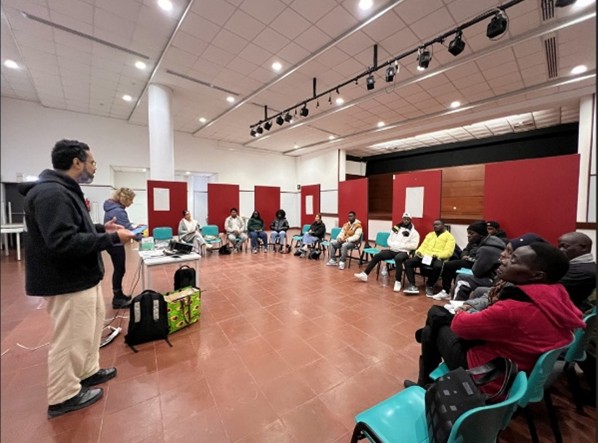
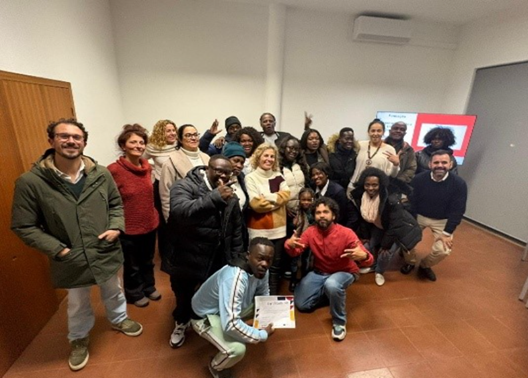
In total, 36 people from diverse communities and Civil Society Organisations took part in several trainings.
Dialogue for Peaceful Change (DPC) training
During February 2025, a targeted capacity-building training was delivered by Fryshuset to strengthen dialogue and conflict management competencies among representatives of faith-based civil society organisations. A need that was visible already early on in the project, due to increased polarisation between different groups in Sweden, which has been observed as a challenge to participation for people from different cultural and religious backgrounds.
The training brought together members and active representatives from the Interreligious Council of Sweden (Sveriges interreligiösa råd, SIR), representing diverse faith communities. Participants were individuals engaged in interfaith collaboration and community-based dialogue work, seeking to strengthen their ability to manage tensions constructively and foster trust across religious boundaries, and through that increase solidarity and possibilities for participation for young people from different religious faiths on the diverse community they live in. The facilitators introduced practical tools for conflict understanding, analysis, and mediation, drawing on a peacebuilding approach originally developed in Northern Ireland.
Participants reported increased confidence in approaching sensitive or conflict-prone situations and highlighted the value of structured tools for understanding underlying dynamics in intergroup relations. The interactive format supported peer learning and reflection, contributing to strengthened trust and shared understanding among participants from different religious backgrounds.
Training on Participation & Democracy
Between March and September 2025, the project team also contributed to the design, planning, and facilitation of a training on participation and democracy for youth workers and managers of youth centres ran by Fryshuset in partnership with Nacka Municipality. This process revealed a knowledge gap among participants regarding democratic tools that can support meaningful youth participation, which the final training programme aimed to contribute towards.
Fryshuset Foundation aims to enable every young people to feel included in society, to see themselves as part of it, and to actively contribute to social development. A key element of this ambition is strengthening democratic awareness and participation among young people through the work of youth professionals.
The purpose of this training programme was to increase the knowledge and capacity of youth workers and managers in three youth centres in Nacka Municipality in Sweden, regarding democracy and civic influence. By strengthening their understanding of democratic processes and societal participation, the programme seeks to enhance their ability to support and promote young people’s influence, engagement, and active citizenship within their daily work.
According to participant evaluations, the training helped strengthen inspiration, knowledge, and understanding among youth leaders and coordinators. One of the tools that several participants mentioned as most useful was a list with suggestions of how to support young people’s influence, participation and advocacy. Another part was an inspirational session from a youth activist working to increase youth influence regarding climate issues, but also providing the training participant with knowledge regarding how to engage voluntarily for different causes and issues, where the participants learned about platforms for engagement that were new to them.
Building on these insights, the training concept will continue to be further developed within Fryshuset, drawing on knowledge generated through Sol4All, with the aim of scaling and disseminating it to additional programmes both within and beyond the network.
Throughout the project, dialogue was also initiated with organisations and municipal representatives beyond the primary implementation areas. For example, discussions were held with associations in Haninge Municipality regarding needs and aspirations for strengthening youth participation. Due to an ongoing organisational restructuring within the municipality, no formal training activities could be implemented during the expected period. However, joint design and planning processes were initiated to enable future capacity-building efforts once the new organisational structure is fully established.
Greece
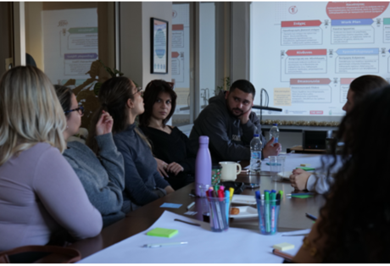
In Greece, 33 people took part in training for Civil Society.
Two capacity-building trainings for Civil Society Organizations (CSOs) were conducted in Thessaloniki, Greece under the framework of the Solidarity4All project, based on the priorities and needs identified through the Communities of Practice meetings. Both trainings followed the same agenda and were delivered in a hybrid format, allowing participants to join either in person or online. This format was selected to ensure broad participation, particularly for representatives living in other cities or those unable to attend physically.
Attendees included representatives from various NGOs and community groups, some of whom joined from different cities via a hybrid format. The group was characterized by a need to address fragmentation within the civil society ecosystem, overcome barriers faced by informal groups and strengthen skills in community mobilization and local project design.
Each training took place from 09:00 to 19:00, with a total duration of 10 hours, including scheduled breaks. The agenda covered a wide range of thematic areas essential for strengthening CSO operations and supporting their role in designing and implementing local solidarity actions.
In response to the perspectives shared through the Communities of Practice, the training agenda was developed to address both foundational and practical dimensions of civil society work. The sessions included thematic modules on Diversity, Equity & Inclusion; the formation of stereotypes and unconscious bias; administrative and partnership management for CSOs; financial management and fundraising; communication and social media strategies; and the design and planning of local solidarity projects to be carried out by April. This structure ensured that participants not only gained theoretical understanding of inclusion and discrimination dynamics but also acquired concrete tools to strengthen their organizational capacity, collaboration methods, and project implementation skills.
The training demonstrated high effectiveness in meeting participant expectations and enhancing their self-perceived competencies. Comparative analysis of the pre- and post training surveys revealed a notable increase in confidence across all measured areas, with the most significant gains observed in participants’ ability to encourage community activity and effectively use group activities for decision-making directly addressing core learning desires related to mobilization and participation. Furthermore, the overall training execution was rated exceptionally high, with participants expressing strong satisfaction concerning the supportive learning environment, the constructive group dynamics, and the clarity facilitated by the practical exercises. Future sessions can be strengthened by integrating qualitative feedback, which suggested reducing text on presentations and encouraging trainers to rely less on structured reading in favour of more illustrative examples
The evaluation revealed a significant and noticeable increase in participants’ self-perceived skills, particularly in the areas that CSOs had prioritized: community mobilization and the ability to use group activities for effective decision-making. This strong outcome confirms that the training successfully equipped participants with the action-oriented skills necessary to increase community engagement and implement local solidarity projects.
The overall quality of the training execution was exceptionally high. Participants expressed strong satisfaction with the supportive learning environment, the constructive
group dynamics, and the clarity facilitated by the practical, interactive exercises. The trainers’ approach and the creation of a safe atmosphere were particularly well-received. Furthermore, the strategic use of a hybrid format ensured maximum accessibility, successfully including representatives who could not attend in person.
Portugal
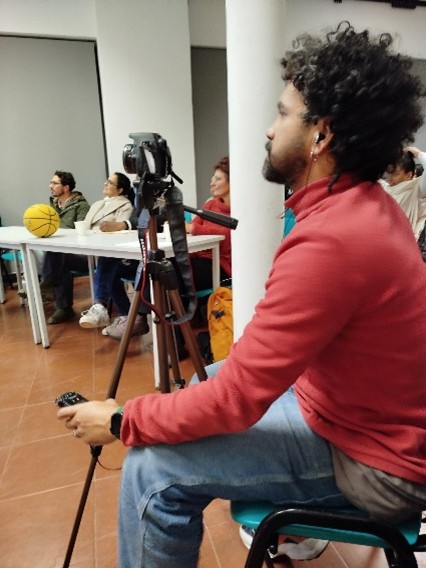
In total, 39 people participated in the trainings for Civil Society Organizations.
The training was designed based on an analysis of the training needs raised in the WP3 – assessment. In Portugal, it is recognised that training can strengthen the sustainability of associations, but the lack of time available limits participation. More than themes, the importance of training adjusted to the level of maturity of organizations and taught by trainers with real associative experience, capable of understanding the context and avoiding inappropriate content, was highlighted.
Therefore, AKF prepared a training entitled ”Community Development and Leadeship”, covering subjects such as Participation and Solidarity; Diversity and Inclusion, Mechanisms and models for participation and solidarity; Planning and designing local projects; Monitoring and evaluating projects.
In Fundão, in conjunction with the local authority, a training modality of 2 consecutive days was chosen. The training had 7 participants and was facilitated by 3 members of the Aga Khan Foundation. The municipality of Fundão and AIMA (online) were also invited for a detailed presentation of participation and solidarity mechanisms. The groundstigator accompanied the entire training.
At the end of the training, the participants were invited to brainstorm ideas for Local Solidarity Activities (WP 7
A final pitch was presented by each group to the Local Authorities representatives, generating great enthusiasm on the part of those present in the implementation of the projects. The groups pitched their proposals for local solidarity activities, to be developed in the following months, with LA – Local Authorities giving their feedback and ensuring their commitment and involvement in the projects presented.
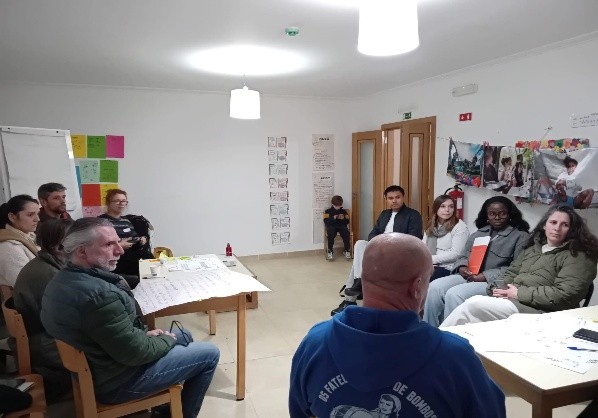
In Loures the training had 32 participants and was facilitated by 3 members of the Aga Khan Foundation. The municipality of Loures and AIMA were also invited for a detailed presentation of participation and solidarity mechanisms. The groundstigator accompanied the entire training
In conjunction with the local authority, a training modality for CSO & UC of 6 days, spread over several weeks, was chosen.
Despite the conditions of the space, they were decorated with training and pedagogical materials that helped to visualize the contents presented, as well as being examples of already tested resources to be used in the mobilization and participation of the community, as happened in Fundão, and therefore, in its likeness. The various posters and sheets resulting from the dynamics carried out were placed, reinforcing the identity of the group and the themes that were addressed.
Although the group was larger than expected, it was decided to accept all the people who wanted to participate and the environment of great expectation on the part of participants was essential to create an atmosphere of trust.
Considering the wide variety of participants’ profiles and their attendance, it was necessary to review the dynamics and reduce the time of some content, ensuring the sharing of the minimum information that would allow them to present a project at the end of the session and learn about local and national mechanisms that would allow them to increase the participation of the communities.
In Loures it was possible to have 3 guests – from the municipality, from AIMA and from the municipal assembly. The latter is a person who lived and is recognized in the neighbourhoods in Loures and who inspired with his history of activism and civic participation.
As with the previous group, at the end of the training the participants were invited to think of ideas for Local Solidarity Activities (WP 7): 3 ideas from 3 groups were presented through a pitch with the proposals for local solidarity activities to be developed in the following months.
For the pitch, Local Authorities were invited, as well as an entity based in the territory, generating great enthusiasm on the part of those present in the implementation of the projects and allowing the immediate exchange of contacts to support the activities presented.
The involvement of municipalities and groundstigators in the mobilization phase was decisive in reaching different audiences, namely people who do not normally participate (and even harbor some mistrust towards institutions), such as young people and women from different backgrounds living in contexts of social exclusion.
The participation of groundstigators in the trainings was essential to create a sense of belonging and closeness with all trainees and groups, essential for the implementation phase of local solidarity projects (WP7). In addition, they supported the recording of images and videos and the management of work with the group. The trainings were considered a success with most participants considering moving on to the implementation of local solidarity activities (WP 7). The presence of guests such as the municipalities and AIMA allowed the understanding in detail of local and national participation opportunities, and also the exchange of contacts. The participation of Local Authorities, as guests in the presentation of the pitches was a very significant moment as it demonstrated the interest of the municipality’s staff and other public and private entities in the project, and mobilized them as a resource for the implementation of the project, and eventually, after the project, reinforcing the local network of CSO partners.
The use of dynamic methodologies, practical examples and group work were appreciated by the trainees. The possibility for AKF to mobilise 3 staff with different backgrounds created an even more appealing learning environment.



Leave a Reply
Want to join the discussion?Feel free to contribute!