Throughout the Solidarity4all project, several debates and think tanks were organized, all with a single goal: to understand how to make European policies more inclusive by increasing the participation of underrepresented communities.
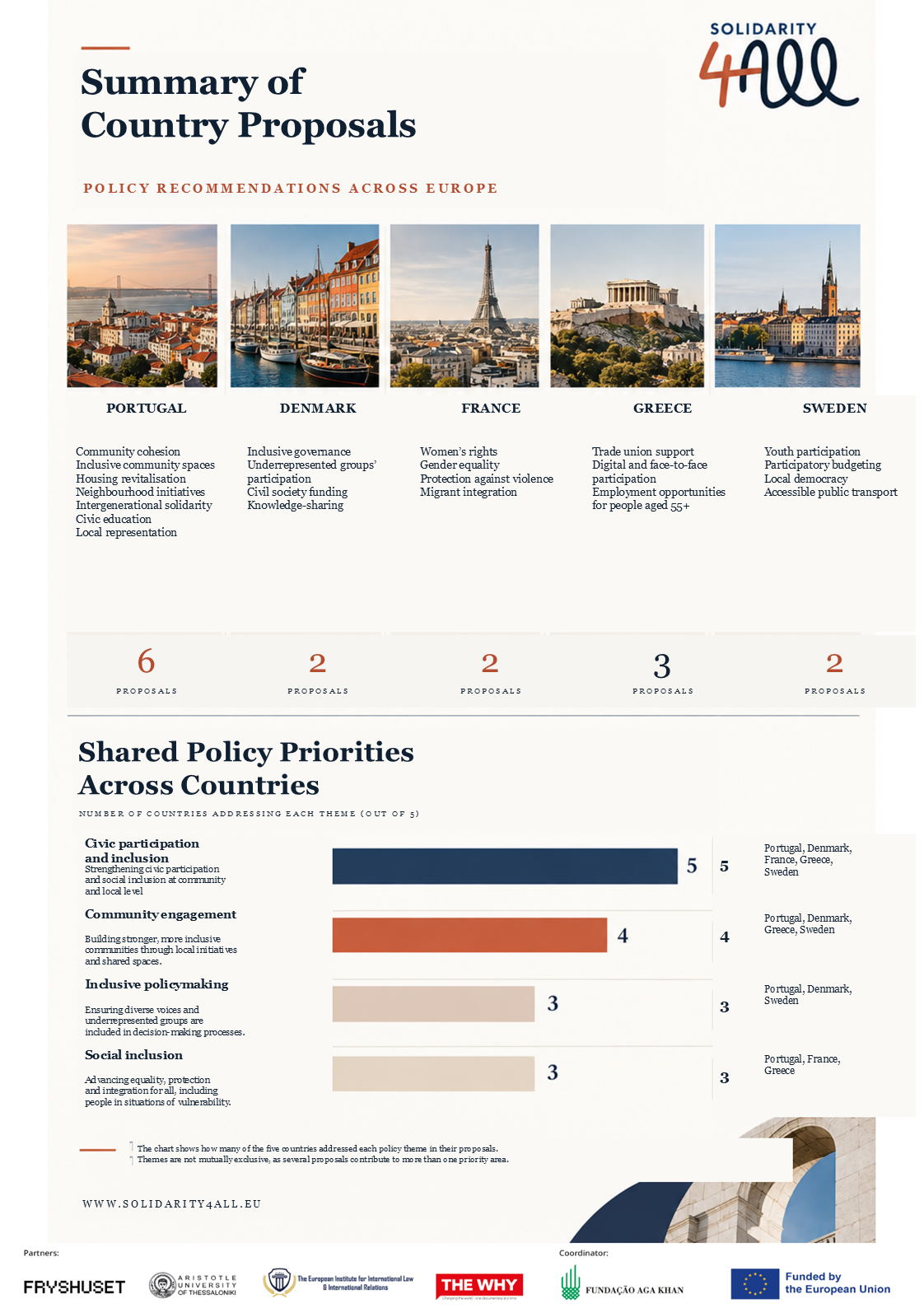
Below, you can find a summary of the various proposals and one infographic, as well as download the final document containing the proposals from the five participating countries:
Full document for Download:
Summary for Download:
Policy Recommendations Across Five European Countries
Executive Summary | Portugal · Denmark · France · Greece · Sweden
Introduction
The Solidarity for All project brought together partner organisations and local stakeholders in Portugal, Denmark, France, Greece and Sweden to examine the barriers that prevent individuals from underrepresented communities from participating fully in society. Through national Think Tank discussions and participatory activities, the partners developed 15 policy recommendations reflecting the social, institutional and territorial challenges identified in their respective contexts.
While the recommendations address different issues, they share a common concern: meaningful participation requires more than the formal opportunity to be heard. People must also have access to the resources, services and decision-making processes that enable them to participate in practice in matters that affect their quality of life. The proposals address civic engagement alongside housing, employment, transport, social inclusion and institutional accessibility.
Portugal | Community Cohesion and Local Participation
Portugal developed six recommendations across the cities of Fundão and Loures, reflecting the different needs of the two municipalities.
In Fundão, the recommendations focus on strengthening inclusive community spaces, bringing vacant housing back into use and supporting neighbourhood initiatives. The first proposal encourages the use of existing public and community facilities to create opportunities for interaction among older residents, young people, migrants and other community members. The second proposes identifying and assessing vacant properties, engaging owners and exploring rehabilitation solutions to improve housing access and support territorial revitalisation. The third recommends supporting small, resident-led projects that strengthen neighbourhood relationships, volunteering and cooperation between local organisations.
In Loures, the recommendations address intergenerational solidarity, citizenship education and democratic participation trough representation. They propose creating more opportunities for older and younger residents to interact, exchange knowledge and participate in community activities. They also emphasise accessible public information, civic education and stronger opportunities for residents to engage in local decision-making and feel represented in decision making processes.
Together, Portugal’s recommendations demonstrate the importance of building on existing municipal resources and community networks while responding to specific social and territorial needs.
Denmark | Inclusive Governance and Civil Society Support
Denmark developed two recommendations addressing barriers to meaningful participation and the sustainability of civil society organisations.
The first proposes stronger representation of underrepresented groups in public debate and decision-making. It calls for earlier involvement in policy processes, permanent advisory mechanisms and practical support that enables people facing exclusion to participate effectively. Public institutions would also be expected to explain how contributions have informed decisions, strengthening accountability and trust.
The second recommendation focuses on improving access to funding and knowledge for civil society organisations, particularly smaller grassroots groups. It proposes a European infrastructure providing transparent funding information, accessible resources, opportunities for cooperation and knowledge from existing projects. The objective is to reduce administrative barriers, improve coordination and allow organisations to devote more resources to their work with communities.
France | Gender Equality and Migrant Integration
France’s two recommendations address structural inequalities that restrict access to rights, services and opportunities.
The first focuses on strengthening women’s rights and gender equality through improved legal protection, support for survivors of gender-based violence, fairer employment conditions and greater representation in decision-making. It emphasises that formal equality must be accompanied by effective implementation and accessible support.
The second recommendation addresses language and administrative barriers affecting people with a migrant background. It proposes more accessible language learning, simplified administrative procedures, improved recognition of qualifications and coordinated integration services. By reducing these obstacles, the proposal seeks to facilitate access to employment, education, essential services and community participation.
Both recommendations highlight the responsibility of institutions to make rights and services genuinely accessible.
Greece | Practical Solidarity and Inclusive Employment
Greece developed three recommendations connecting social participation with practical support and opportunities.
The first proposes strengthening the role of trade unions by expanding the services they provide to workers, particularly in tourism and hospitality. Suggested measures include career guidance, skills development and accessible legal advice, alongside more transparent funding and oversight.
The second recommends combining digital participation tools with face-to-face community engagement. It proposes digital-skills training, particularly for older residents, and participation processes that retain opportunities for in-person discussion. Technology is presented as a means of strengthening community relationships rather than replacing them.
The third recommendation, Programme Nestor, proposes a municipal employment pathway for unemployed residents aged 55 and over. Through targeted training, individual support and cooperation with employers, it seeks to address age discrimination and improve opportunities for economic and social participation.
Sweden | Youth Participation and Transport Accessibility
Sweden developed two recommendations responding to the experiences of young people in Arvika, particularly those living in rural areas.
The first proposes strengthening youth participation in local democracy through participatory budgeting and formal youth hearings. Young residents would have opportunities to propose, evaluate and select projects supported by municipal resources, while their views would be formally considered in planning decisions.
The second focuses on improving public transport accessibility. Limited evening and weekend services can prevent young people from accessing sports, cultural activities and community spaces. The recommendation proposes more reliable and flexible transport, including demand-responsive services, alongside youth involvement in route planning and transport decisions.
Together, these proposals recognise that young people need both opportunities to influence decisions and practical means of accessing community life.
Shared Priorities and Conclusions
Across the five countries, civic participation, social inclusion and cooperation between public institutions and communities emerge as recurring priorities. However, the recommendations approach these objectives from different perspectives, reflecting the needs of the populations and territories involved.
Several proposals focus directly on participation mechanisms, including advisory panels, participatory budgeting, civic education and community-led initiatives. Others address the practical conditions that determine whether participation is possible, such as access to housing in Fundão, employment opportunities in Greece, integration services in France and public transport in Sweden.
The recommendations also demonstrate the importance of recognising locally specific challenges. Although some themes recur across countries, their proposed solutions are not interchangeable. Effective implementation depends on the institutional capacities, community resources and social circumstances of each setting.
Taken together, the 15 recommendations provide a shared direction for strengthening solidarity across Europe: public policies should not only invite individuals to participate but also address the barriers that prevent them from doing so. By combining institutional accountability, accessible services and locally developed initiatives, the proposals offer practical approaches to building more inclusive, connected and participatory communities.