Solidarity4all ends — summary of our journey together
Solidarity4all: belonging and active citizenship for inclusive European Solidarity, was a 2-year project (2024-2026) led by AKF Portugal and funded by CERV-CITIZENS, EU.
The general objective of Sol4All was to strengthen solidarity ecosystems by increasing the participation of underrepresented communities (UCs) at the local, national, and European levels. This directly relates to the Call’s objective of promoting citizens’ and representative associations’ participation in, and contribution to the democratic and civic life of the Union. More specifically, the proposed Action will focus on solidarity and will address the Call’s thematic priority around engagement of citizens and communities in discussions and action related to solidarity.
To achieve its objectives, Sol4all worked with the following groups:
1. Citizens, with a special focus on underrepresented communities – UC (cf. further below)
2. Civil Society Organisations (CSOs)
3. Local, National, and European decision-makers.
The project was guided by the following objectives:
• Enhancing Citizens and CSOs resources and opportunities for participation.
• Mapping and Improving Participation and Solidarity Mechanisms (at Local, National and European Levels), identifying barriers and improving accessibility and alignment with UCs needs.
• Enhancing National and Local Authorities’ capacity for leveraging participation and ensuring the inclusion and representation of underrepresented communities in the solidarity ecosystems, to build sustainable and inclusive policy solutions.
• Raise awareness of decision-makers at the local, national and EU level on the importance of participation for solidarity, belonging and social cohesion to influence policymaking.
Sol4all had partners in 5 EU countries:
Sweden: Fryshuset Foundation
Greece: Aristoteles University of Thessaloniki
Denmark: The WHY foundation
France: European Institute for International Law and International Relations
Associated national partners in each country:
Portugal: Portuguese migration agency – AIMA, city of Fundão, city of Loures
Greece: NGO Citizen Crossroads, European Youth Parliament Greece and the Municipal Youth Council of Thessaloniki
Sweden: city of Arvika, city of Fen and city of Hannige
2. Activities performed and main achievements & outcomes of the action
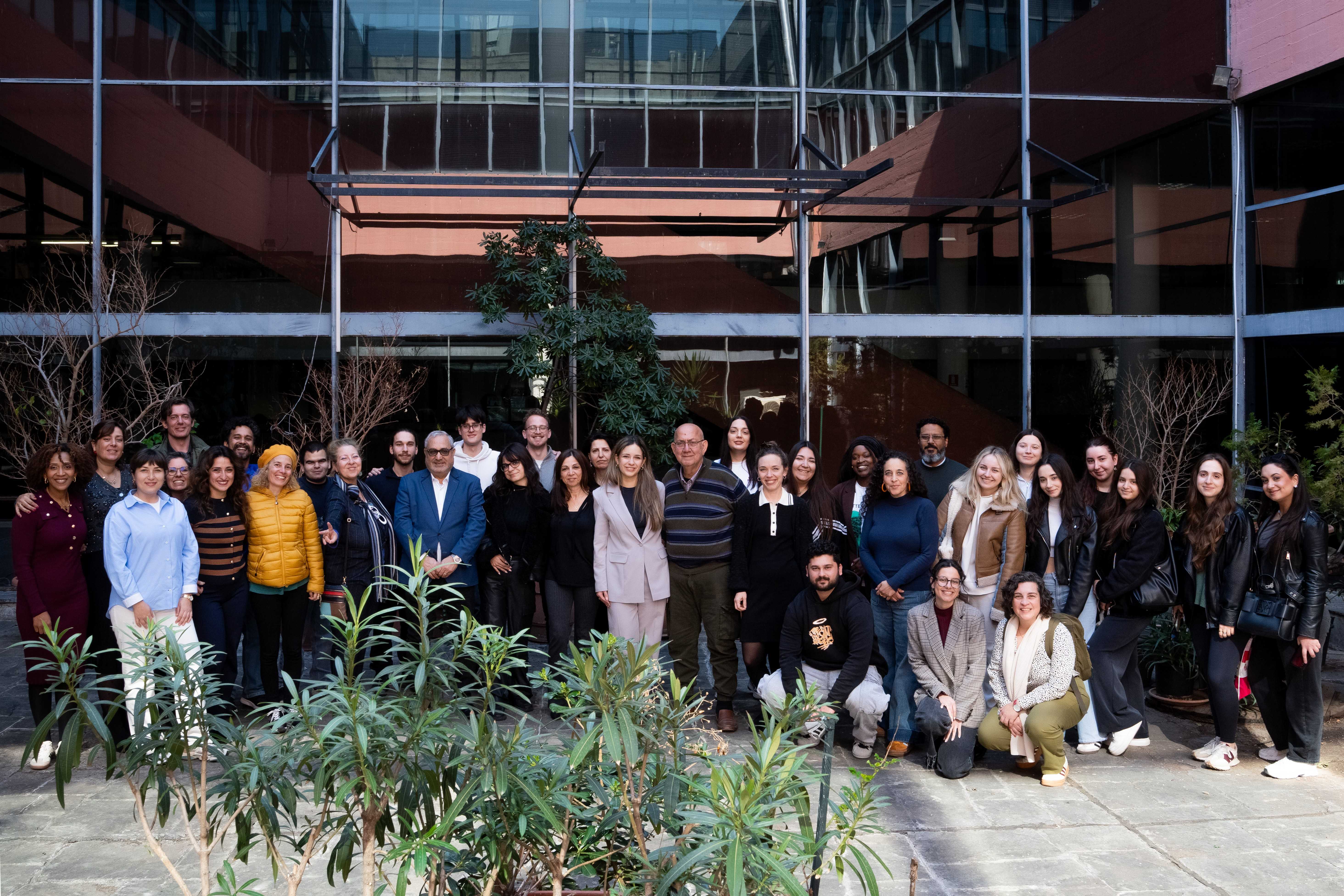
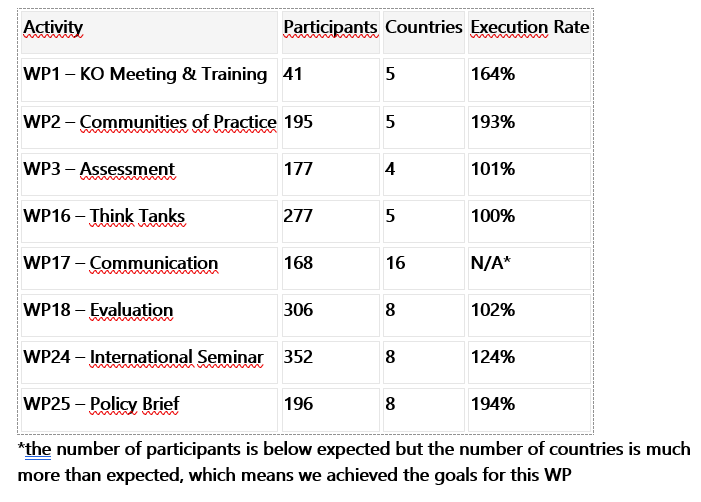
The project started with a mutual training week held in Lisbon in November 2024. At this meeting, each partner shared their knowledge and relevant expertise with the remaining partners, thus contributing to the enrichment of the following project activities. The last day was held in the city of Loures, one of the national non-financial partners, with an open session for the community (several CSOs from Loures took part) and other non-financial parters (such as the national Portuguese migration agency – AIMA, the NGO Citizen Crossroads, Greece, city of Arvika, Sweden, city of Fundão, Portugal and city of Hannige, Sweden) for a mutual exchange of practices and the auscultation of community and CSO members. In total, 41 people participated from all 5 countries (164% of the proposed target). Know more here: Mutual Training Lisboa 2024.
Across the project length, an International Community of Practices continued fostering the exchange of practices and the mutual learning among partners form all 5 countries. National Communities of Practice were also promoted in all 5 countries. Sessions about Human Centred Design, Photovoice, Futures Search and Groundstigators were promoted to ensure all partners had the tools to implement the activities. Meetings were open to non-financial partners, to engage them in the project activities. 195 people participated in these learning moments (193% of the proposed target). Learn more here.
Next, the partners prepared and implemented an assessment, using surveys, interviews and focus groups with diverse community members, CSOs and NGOs representatives, Local Authorities (Las) staff and Decision makers at local and national levels. The assessment engaged 177 people from 4 countries (Portugal, Sweden and Greece + France), reaching 101% of the proposed target. Know more about this activity here: Sol4All assessment.
With the results of the assessment, a plan was designed to implement the next activities:
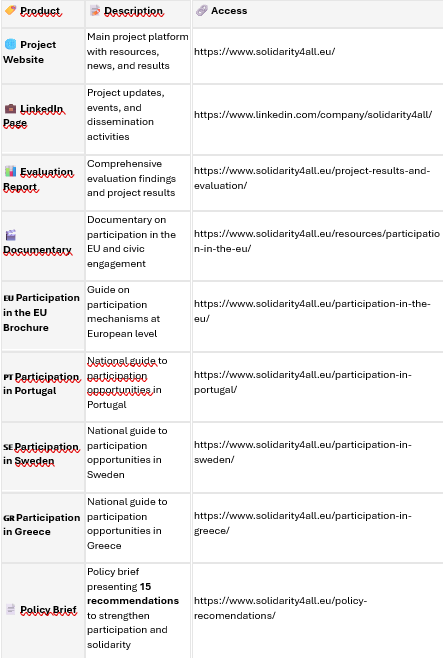
• Pathways for participation (WP 4,5,6): in Greece, Portugal and Sweden, an assessment of mechanisms and tolls for civic participation and solidarity was conducted and leaflets with relevant information on how to participate were built, tested and distributed in al 3 countries. 212 people participated in this activity (139% of the proposed target). Learn more here.
• Training for CSOs (WP 10, 11 and 12): in Greece, Portugal and Sweden, a training was prepared and implemented for local CSOs, to enhance capacity for participation and solidarity at the local and national level. 108 people from diverse backgrounds took part in these trainings, reaching 144% of the total target. Know more here: CSOs trainings.
• Training for LAs (WP 13,14 and 15): in Greece, Portugal and Sweden, training was also held for Local Authorities, to better prepare officers with tools to engage diverse communities in participation and solidarity activities. 111 officers took part in the trainings (148% of the initial target). Know more here: LAs trainings.
• Local Solidarity Activities (WP 7,8 and 9): in Greece, Portugal and Sweden, CSOs and representatives of the underrepresented communities targeted were invited to present and implement small projects and activities. These were financed and supported by the project and non-financial partners such as municipalities. These activities reached 273 people (121% of the initial target). Know more by reading our news here: Local Solidarity Activities.
Additionally, all 5 countries held national Think Thanks (WP 16) to discuss barriers to participation and solidarity and collect proposals to overcome them. An international Think Thank in Greece assembled all the proposals and allowed for an EU level discussion on the topic. 277 people took part in the several activities (reaching 100% of the proposed target). Know more about the Think Tanks here: Think Tanks news.
Regarding communication (WP 17) a Communication Plan was designed, and a Documentary was produced and launched in a webinar. The documentary featured several participants in the project such as community leaders, CSO members, LA officers and Decision makers and was also screened in the several local communities engaged, with follow-up debates. 168 people from 16 countries (the number of participants is below expected but the number of countries is much more than expected) participated. A communication campaign was also implemented reaching +15000 people. Watch the Documentary on our website here: Solidarity4All Documentary.
National seminars (WP 19,20,21,22 and 23) were held in each of the 5 countries, allowing for the dissemination of the project results and fruitful debates on the recommendations prosed I each country. The sharing of impressions about the project and the diverse experiences with the activities were also an added value. In total, 293 people participated in the national seminars, reaching 115% of the estimated target). To know more, read the dedicated article here: National Seminars News
One International seminar (WP 24) was held in May 2026, as well as several follow up events, to disseminate the results of the project at an international level. In total 352 people from 8 countries (124% execution) participated in these events. Know more about the first event in Brussels in May 2026 here: International event May 2026.
A Policy Brief (WP 25) collected all the proposals from each country in one document, that was disseminated trough the Communication Campaign. The proposals were presented to 196 national and local Decision makers from 8 countries. Get to know the full 15 recommendations collected here.
Across the project, a Theory of Change-based Evaluation Plan (WP18) assessed change across the five countries through triangulated qualitative, quantitative and practice-based evidence. It included 20 validated focus group/interview units in Portugal, Greece and Sweden, an online questionnaire with 70 respondents across four countries, 9 Local Solidarity Activity evaluations, National Think Tanks in all five countries, and evidence from National and International Seminars. 306 people from 8 countries (101% execution) took part in the evaluation activities.
Across its five implementing countries, SOL4ALL strengthened the conditions, capacities, practices and relationships needed for more meaningful and inclusive participation among under-represented communities, community leaders, grassroots and civil society organisations, local and municipal authorities and services, community-based intermediaries, and other institutional actors and decision-makers. A Theory of Change-based Evaluation Plan (WP18), drawing on focus groups, interviews, questionnaires and evidence from project activities, found credible evidence of stronger understanding of meaningful participation, increased confidence and agency among some participants and, most clearly, changes in applied participatory practice, including more deliberate facilitation, outreach, delegation, co-design, feedback, organisational navigation and supported leadership. The project also strengthened cross-sector relationships and collaboration, including new or more usable connections between community organisations and CSOs, between communities and public authorities, across municipal departments and services, and between young people and other under-represented participants and institutional actors and decision-makers. It also enabled participant-generated policy, practice and process recommendations across all five countries through National Think Tanks, Seminars and international dialogue. Early institutional effects were visible in selected settings, including changes in municipal and service practices, service design, feedback mechanisms and cross-organisational collaboration, while wider institutionalisation and policy uptake remain longer-term pathways. Overall, SOL4ALL generated both observable changes and tested participation mechanisms, relationships and recommendations that provide a foundation for continued institutional and policy change beyond the project period.
Download here the full Evaluation report.
Results:
In total the project achieved around 2000 unique participants!
🌍 Project Impact by Country:
🇵🇹 Portugal
Activities Delivered
🎓 WP4 – Pathways Portugal
👥 52 participants | 📈 102%
❤️ WP7 – Local Solidarity Activities
👥 81 participants | 📈 108%
🏢 WP10 – Training CSOs
👥 39 participants | 📈 156%
🏛️ WP13 – Training Local Authorities
👥 34 participants | 📈 136%
🎤 WP19 – National Seminar Portugal
👥 57 participants | 📈 112%
________________________________________
🇬🇷 Greece
Activities Delivered
🛤️ WP5 – Pathways Greece
👥 90 participants | 📈 176% ⭐
❤️ WP8 – Local Solidarity Activities
👥 79 participants | 📈 105%
🏢 WP11 – Training CSOs
👥 36 participants | 📈 144%
🏛️ WP14 – Training Local Authorities
👥 34 participants | 📈 136%
🎤 WP20 – National Seminar Greece
👥 53 participants | 📈 104%
________________________________________
🇸🇪 Sweden
Activities Delivered
🛤️ WP6 – Pathways Sweden
👥 70 participants | 📈 137%
❤️ WP9 – Local Solidarity Activities
👥 113 participants | 📈 151% ⭐
🏢 WP12 – Training CSOs
👥 33 participants | 📈 132%
🏛️ WP15 – Training Local Authorities
👥 43 participants | 📈 172% ⭐
🎤 WP21 – National Seminar Sweden
👥 63 participants | 📈 124%
________________________________________
🇫🇷 France
🎤 WP22 – National Seminar France
👥 68 participants | 📈 133%
________________________________________
🇩🇰 Denmark
🎤 WP23 – National Seminar Denmark
👥 52 participants | 📈 102%
🌍 International & Multi-Country Activities
🏷️Project Products & Resources
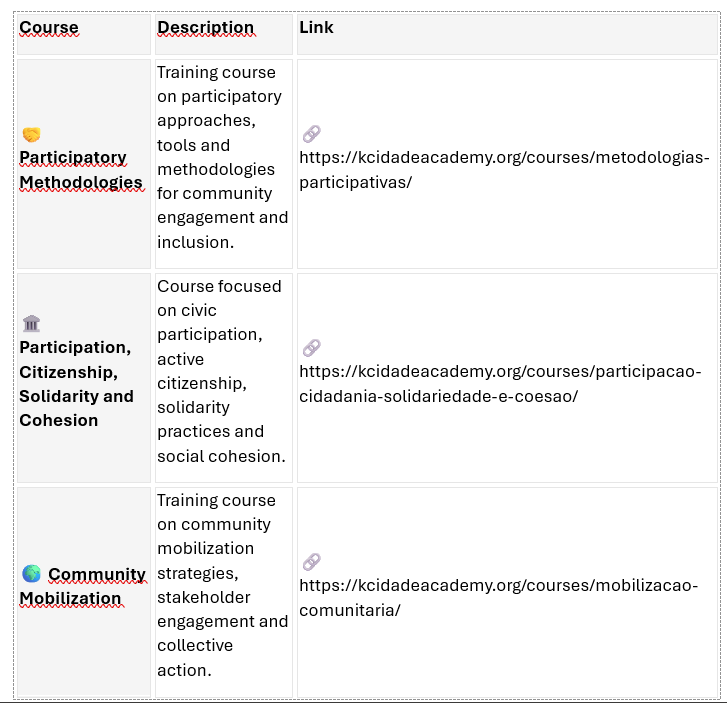
🎓 Training Courses Developed

Leave a Reply
Want to join the discussion?Feel free to contribute!